
Introduction
You have a great idea, a small team, and almost no budget. Sound familiar? Most founders start exactly here. The good news is, you do not need a famous name or a Silicon Valley network to raise money. What you do need is a smart startup booted fundraising strategy.
Bootstrapped or pre-revenue startups can absolutely attract serious investors. But you need to play the game differently. You need to build trust fast, tell your story clearly, and target the right people at the right time.
In this article, you will learn a complete startup booted fundraising strategy that works in the real world. We cover everything from building traction before you pitch to closing your first check. Whether you are raising a pre-seed round or targeting your Series A, these steps apply.
Why Most Startups Fail to Raise Money (And What You Can Do Differently)
Every year, thousands of startups try to raise money. Very few succeed. According to Fundz data, only around 0.05% of startups ever raise venture capital. That number is sobering. But it does not mean you are out of options.
Most startups fail to raise because they approach fundraising the wrong way. They build a deck, send cold emails, and wait. That strategy rarely works. Investors get hundreds of pitches every week. They fund founders they know, like, and trust.
A strong startup booted fundraising strategy flips this around. Instead of chasing investors, you attract them. You build something worth investing in. You let your traction do the talking.
Common Fundraising Mistakes Founders Make
- Pitching too early before any meaningful traction
- Targeting the wrong type or stage of investor
- Sending generic cold outreach with no personalization
- Focusing too much on the product and too little on the market
- Having no clear ask or defined use of funds

Step 1: Build Traction Before You Pitch
Traction is your best fundraising tool. It is the proof that your idea is not just an idea. It shows investors that real people care about what you are building. You do not need millions of users. Even small signals matter enormously.
Start by getting your first ten customers. Talk to them. Understand their pain. Use their feedback to improve your product. This loop builds real traction fast. Investors notice when you can say, « We have 50 paying customers and a 90% retention rate. »
A startup booted fundraising strategy built on early traction gives you leverage. You stop begging for meetings. Instead, investors start requesting them.
Types of Traction That Impress Investors
- Monthly recurring revenue (MRR) showing consistent growth
- User growth measured week over week
- Signed letters of intent (LOIs) from potential customers
- Strong engagement metrics like daily active users and session time
- Strategic partnerships or pilot programs with recognized brands
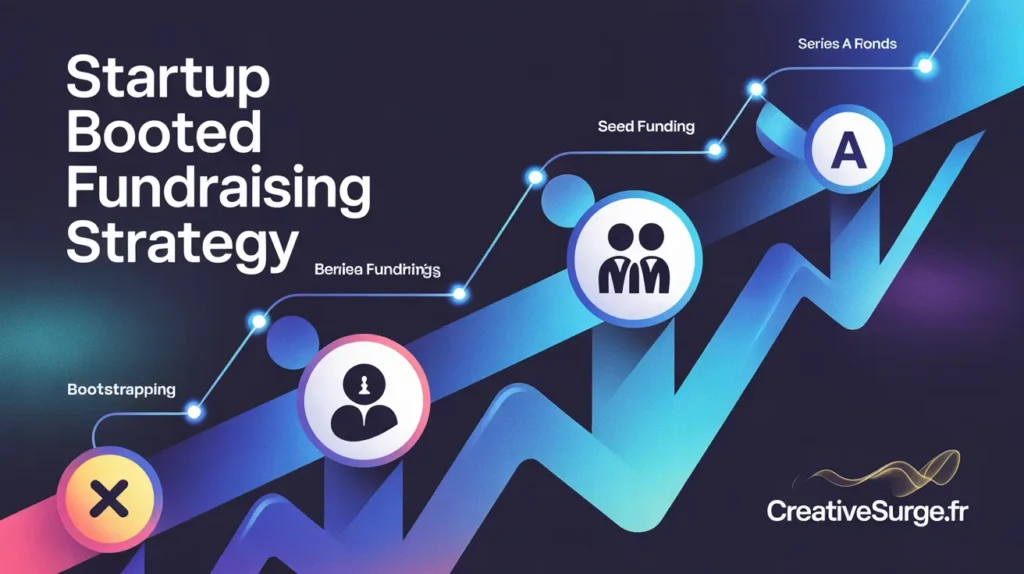
Step 2: Know Your Funding Options Inside Out
One of the biggest mistakes early founders make is thinking venture capital is the only path. It is not. Your startup booted fundraising strategy should consider multiple funding sources. Each one has pros and cons. Knowing which fits your stage and goals is critical.
Funding Options Every Founder Should Know
Bootstrapping
You fund the company yourself. You keep 100% equity. This works well for low-overhead software businesses. It forces you to be lean and customer-focused from day one.
Angel Investors
Angels are high net worth individuals who invest their own money. They typically invest between $10,000 and $500,000. They often take equity and sometimes offer mentorship. Platforms like AngelList and Gust help you find them.
Venture Capital
VCs invest larger amounts in exchange for equity. They expect high growth and big exits. This path is competitive. You need strong traction, a sizeable market, and a scalable business model.
Crowdfunding
Platforms like Kickstarter, Indiegogo, and Republic let you raise from the public. This approach works especially well for consumer products and community-driven businesses.
Grants and Competitions
Non-dilutive capital is gold. Government grants, startup competitions, and accelerator programs give you money without taking equity. Apply to every one you qualify for.
Step 3: Craft a Pitch That Investors Cannot Ignore
Your pitch is your first impression. It needs to be clear, confident, and compelling. A great pitch tells a story. It answers the investor’s biggest question: « Why should I care about this right now? »
Your startup booted fundraising strategy must include a killer pitch deck. Keep it to 10 to 15 slides. Every slide should earn its place. Investors have seen thousands of decks. Yours needs to stand out fast.
The Ideal Pitch Deck Structure
- Problem: What pain are you solving?
- Solution: How do you solve it uniquely?
- Market Size: How big is the opportunity?
- Traction: What have you achieved so far?
- Business Model: How do you make money?
- Team: Why are you the right people to build this?
- Competition: Who else plays in this space?
- Financials: What does growth look like in 3 to 5 years?
- The Ask: How much do you need and what will you use it for?
Step 4: Build Your Investor Pipeline Like a Sales Funnel
Fundraising is a numbers game with relationship elements. You need to talk to a lot of investors to close a round. The best startup booted fundraising strategy treats investor outreach like a structured sales process.
Start by building a list of 100 to 200 investors who focus on your industry and stage. Research each one. Read their portfolio companies. Follow their social media. Understand what they care about. Then personalize every single outreach message.
Warm introductions convert at a much higher rate than cold emails. Use LinkedIn, mutual connections, accelerators, and events to get introduced. A single warm intro can open doors that hundreds of cold emails cannot.
Track every conversation in a CRM. Know where each investor stands. Follow up consistently but not aggressively. Use every « no » to improve your pitch for the next conversation.
Step 5: Nail the Due Diligence Process
An investor says yes to a meeting. You nail the pitch. Now comes due diligence. This is where many deals fall apart. Your startup booted fundraising strategy must prepare you for this phase well in advance.
Investors will look at your financials, legal documents, team backgrounds, customer contracts, and technology. Get these in order before you start fundraising. Use a data room to keep everything organized and accessible.
Due Diligence Checklist for Early-Stage Startups
- Certificate of incorporation and shareholder agreements
- Audited or reviewed financial statements if available
- Cap table showing all equity holders clearly
- Customer contracts and key commercial agreements
- IP ownership documentation and any patents filed
- Employment agreements and equity grants for the core team
Step 6: Use Storytelling to Create Emotional Investment
Numbers matter. But stories close deals. Investors fund people, not just businesses. Your personal story, your « why, » and your vision for the future make you memorable. No one remembers slide 7 of a pitch deck, but they remember a founder who made them feel something.
Share the moment you discovered the problem. Talk about a real customer whose life your product changed. Paint a vivid picture of what the world looks like when you win. This emotional layer is what separates a forgettable pitch from a fundable one.
A complete startup booted fundraising strategy always includes a narrative layer. Logic gets attention. Emotion gets commitment.
Step 7: Leverage Accelerators and Incubators
If you are at an early stage, consider applying to a top accelerator. Programs like Y Combinator, Techstars, and 500 Startups do more than give you money. They give you credibility, mentorship, and warm investor introductions.
Getting into a top accelerator can transform your startup booted fundraising strategy overnight. Investors trust the signal. They know these programs filter for quality. A program stamp alone can help you raise your round faster and at a better valuation.
Even if you do not get into a top-tier program, regional and niche accelerators offer real value. Look for ones that specialize in your industry or target market. The network access alone is worth it.
Step 8: Time Your Fundraise for Maximum Impact
Timing matters more than most founders realize. You want to fundraise when momentum is on your side. Start conversations when your metrics are growing, not when they are flat or declining.
Create urgency without faking it. If you have multiple investor meetings lined up, let each investor know. Investors move faster when they fear missing out. Use a healthy competitive dynamic to your advantage.
The best time to execute your startup booted fundraising strategy is when you do not desperately need the money. That sounds counterintuitive, but investors can sense desperation. Build enough runway so you can raise from a position of real strength.
Step 9: Negotiate Terms Like a Pro
Getting a term sheet is exciting. But do not sign the first one you receive without fully understanding it. Your startup booted fundraising strategy should include solid basic knowledge of deal terms.
Understand your valuation, dilution, liquidation preferences, pro-rata rights, and board composition. Hire a startup attorney. The legal cost is worth it. A bad term sheet can limit your options for years to come.
The best investors are partners, not just check writers. Choose investors who add value beyond money. The right partner opens doors, makes introductions, and helps you navigate rough patches.
How to Maintain Momentum After Closing Your Round
Raising money is not the finish line. It is the starting gun. After you close, send a thank-you note to every investor you spoke with, even those who passed. Markets change. People change. The investor who passed today might lead your next round.
Keep your investors updated with monthly or quarterly reports. Share wins, challenges, and key metrics. Investors who feel included become advocates. They make introductions and help you navigate tough decisions.
Your startup booted fundraising strategy should never stop evolving. Every round teaches you something new. Use those lessons to refine your pitch, improve your metrics, and build deeper investor relationships.
Conclusion: Your Fundraising Journey Starts Today
Fundraising is hard. There is no way around that. But with the right startup booted fundraising strategy, you can absolutely raise money, even without connections, even without a track record, and even in a tough market.
Start by building traction. Know your funding options. Craft a compelling pitch. Build your investor pipeline. Prepare for due diligence. Tell your story. Time your raise wisely. And negotiate smart. These steps work because they are built around how investors actually think and behave.
The startup booted fundraising strategy you have just read is your blueprint. Now it is time to execute it. Take one step today. Research one investor. Draft one slide. Start one conversation. That first step is often the hardest, but it is also the most important one you will take.
What part of fundraising do you find most challenging right now? Drop a comment, share this article with a fellow founder, or bookmark it for your next raise.

Frequently Asked Questions (FAQs)
1. What is a startup booted fundraising strategy?
A startup booted fundraising strategy is a structured plan that helps early-stage and bootstrapped startups raise money efficiently. It covers everything from building traction to pitching investors and closing deals.
2. How much money should I raise in my first round?
Raise enough to reach your next meaningful milestone, typically 12 to 18 months of runway. Avoid raising too little or too much. Too little and you run out before hitting targets. Too much and you give away unnecessary equity early.
3. When should a startup start fundraising?
Start fundraising when you have clear traction, a validated idea, and a well-defined use of funds. Raising too early without product-market fit is very difficult. Investors need to see proof that your idea actually works.
4. What is the best way to find startup investors?
Use platforms like AngelList, Crunchbase, and LinkedIn. Attend startup events and pitch competitions. Join accelerators. Ask your network for warm introductions. These methods work far better than cold email outreach.
5. Do I need a business plan to raise funding?
Most modern investors prefer a strong pitch deck over a traditional business plan. Your deck should cover the problem, solution, market, traction, team, and financials. A one-page executive summary also helps for initial outreach.
6. How long does it take to raise a seed round?
Typically three to nine months, depending on your traction, network, and market conditions. Some founders close faster with strong momentum. Others take longer in difficult market environments. Start earlier than you think you need to.
7. Can bootstrapped startups attract VC funding?
Absolutely. Many successful VC-backed companies started bootstrapped. Bootstrapping shows discipline, customer focus, and resourcefulness, all qualities investors deeply admire. When you do approach VCs, your sustainability track record becomes a major advantage.
8. What is a SAFE note and should I use one?
A SAFE (Simple Agreement for Future Equity) is a popular instrument for early-stage fundraising. It converts to equity in a future round. It is simpler than a convertible note and faster to close. Many angel investors and accelerators prefer it.
9. How do I prepare for investor due diligence?
Build a data room with your legal documents, financials, cap table, customer contracts, and IP documentation. Keep it organized and always up to date. Being well-prepared for due diligence shows professionalism and builds real investor confidence.
10. What happens after I close my funding round?
Execute your plan immediately. Send investor updates regularly. Build toward your next milestone. Stay in touch with investors who passed, as they may participate in future rounds. Use the capital wisely and keep your burn rate under control.
Also Read Creativesurge.fr
Email: johanharwen314@gmail.com
Author Name: Johan harwen
About the Author: Johan Harwen is a startup strategist, business writer, and fundraising consultant with over a decade of experience helping early-stage founders navigate the world of venture capital and angel investing. He has worked with more than 150 startups across SaaS, fintech, and consumer technology, guiding them through seed rounds, Series A pitches, and accelerator applications. Johan is passionate about making fundraising accessible to founders from all backgrounds. He believes that a great idea, backed by the right startup booted fundraising strategy, can win funding from even the most competitive investors.