La Viande de Kobe : L’Exceptionnelle Legende Japonaise qui Va Transformer Votre Rapport au Boeuf 2026

Introduction
Imaginez une tranche de viande si tendre qu’elle fond litteralement sur votre langue avant meme que vous ayez eu le temps de la mastiquer. Imaginez un gout si riche, si profond et si complexe que vous restez silencieux quelques secondes, les yeux mi-clos, simplement pour profiter du moment. Voila exactement ce que l’on ressent la premiere fois que l’on gout la viande de Kobe. Cette viande n’est pas juste un aliment. C’est une experience gastronomique a part entiere.
La viande de Kobe est aujourd’hui reconnue dans le monde entier comme l’une des viandes les plus prestigieuses, les plus rares et les plus couteuseS. Elle vient du Japon, plus precisement de la region de Kobe, et elle est produite a partir d’une race bovine particuliere appelee Tajima-gyu. Ce qui la distingue de toutes les autres viandes, c’est son persillage extraordinaire, cette toile de gras intramusculaire qui lui donne une texture et une saveur incomparables.
Dans cet article, vous allez tout savoir sur la viande de Kobe : son histoire fascinante, ce qui la rend si speciale, comment la choisir, comment la cuisiner, ou la trouver et surtout pourquoi elle vaut chaque centime que vous pourriez depenser pour y gouter.
L’Histoire Extraordinaire de la Viande de Kobe
La viande de Kobe ne s’est pas construite en un jour. Son histoire remonte a plusieurs siecles et elle est profondement ancree dans la culture japonaise. Pour comprendre pourquoi cette viande est aussi speciale, il faut d’abord comprendre d’ou elle vient.
Les Origines : Le Boeuf Tajima au Coeur du Japon Feodal
Le bovin a l’origine de la viande de Kobe est la vache Tajima-gyu, une sous-race de la race Wagyu originaire de la prefecture de Hyogo au Japon. Pendant des siecles, ces bovins etaient principalement utilises comme animaux de trait dans les champs de riz. La consommation de viande au Japon etait d’ailleurs largement limitee par des raisons culturelles et religieuses, notamment bouddhistes.
C’est seulement a partir de l’ere Meiji, au cours du XIXe siecle, que la consommation de boeuf a commence a se developper au Japon. La ville portuaire de Kobe etait l’une des premieres a accueillir des etrangers, et c’est la que ces derniers ont decouvert et commence a apprec la viande de ces bovins locaux. Le nom ‘viande de Kobe’ est ainsi ne a partir de la ville d’exportation.
La Certification Officielle : Une Protection Precieuse
Aujourd’hui, la viande de Kobe beneficie d’une certification stricte delivree par la Kobe Beef Marketing and Distribution Promotion Association. Pour porter le nom de ‘Kobe Beef’, la viande doit repondre a de nombreux criteres tres precis, notamment la race de l’animal, sa region d’elevage, son alimentation et la qualite de son persillage.
En 2012, pour la premiere fois, cette viande d’exception a commence a etre exportee hors du Japon. Avant cette date, si vous vouliez gouter la veritable viande de Kobe, vous deviez voyager jusqu’au Japon. Cette ouverture a l’international a rendu cette viande plus accessible, mais elle reste toujours aussi rare et precieuse.
Ce Qui Rend la Viande de Kobe Veritablement Unique
Quand on parle de la viande de Kobe, on parle souvent de son prix eleve. Mais avant de penser au prix, il faut comprendre pourquoi cette viande est si differente des autres. Il y a plusieurs facteurs cles qui expliquent son caractere exceptionnel.
Le Persillage : L’Art du Marbrage
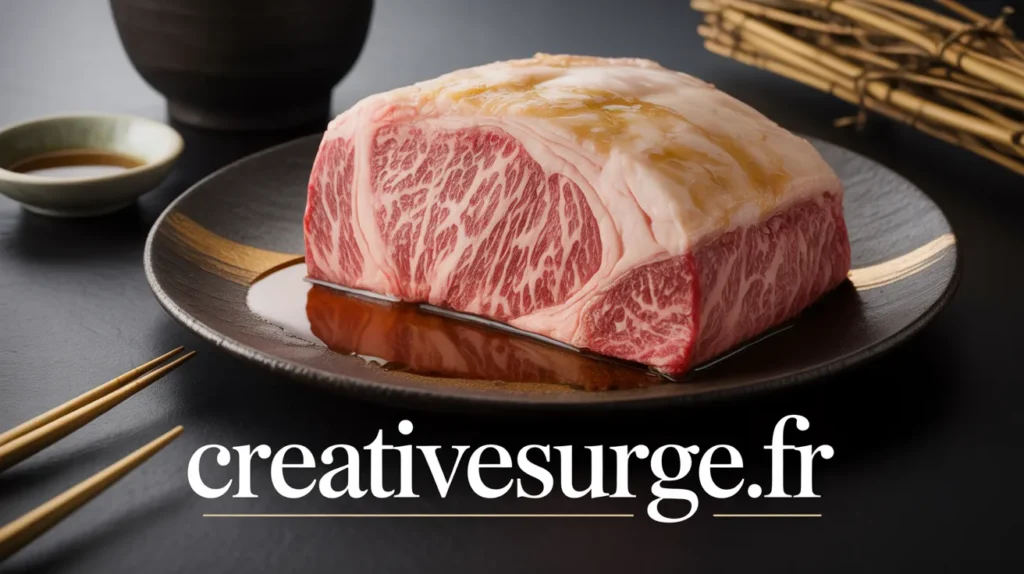
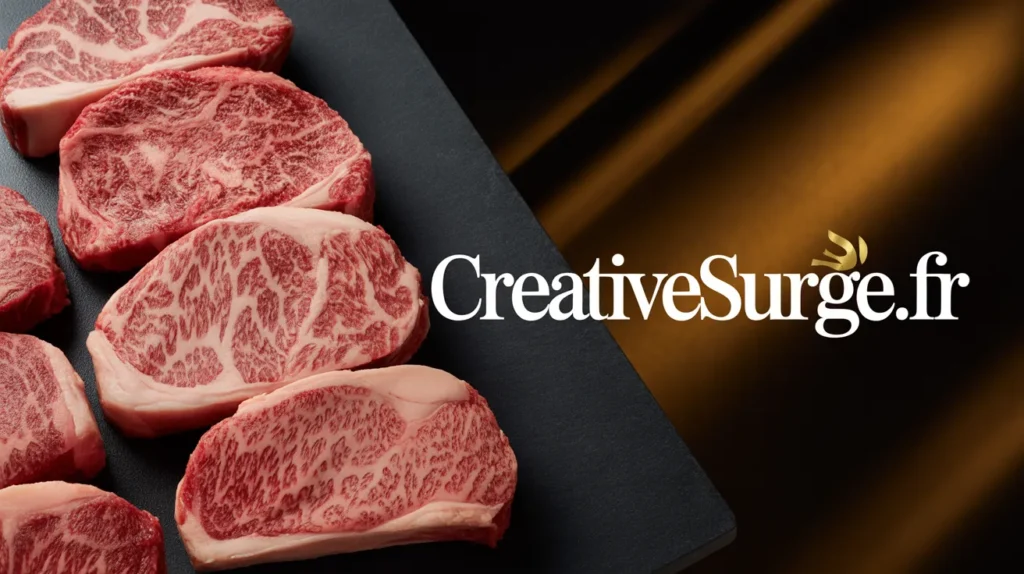
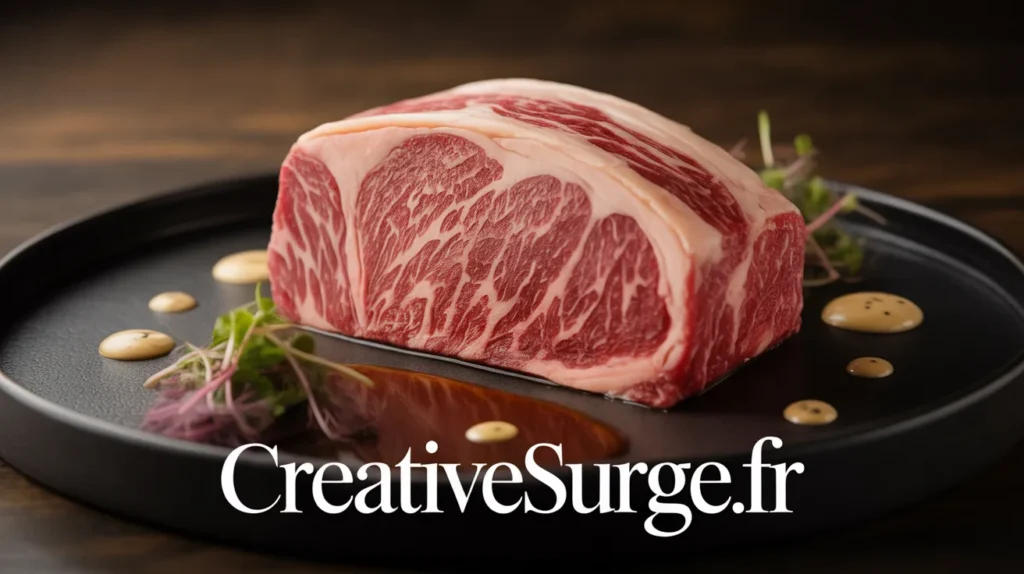
Le premier element qui distingue la viande de Kobe, c’est son persillage exceptionnel. Le persillage, c’est cette repartition du gras a l’interieur du muscle, qui cree un effet marbrie blanc sur fond rouge. Ce n’est pas n’importe quel gras : il s’agit d’un gras intramusculaire tres fin, presque translucide, qui se fond dans la viande a temperature corporelle.
Ce gras particulier a un point de fusion tres bas, autour de 25 a 30 degres Celsius. Concretement, cela signifie qu’il fond litteralement dans votre bouche. C’est ce qui donne cette sensation unique de fondant que vous ne trouvez nulle part ailleurs. Plus le marbrage est eleve, plus la viande est consideree comme de haute qualite.
L’Elevage Exceptioennel des Bovins Tajima
L’elevage des bovins destines a produire la viande de Kobe est un processus long, minutieux et couteux. Les animaux sont eleves dans des conditions tres specifiques dans la prefecture de Hyogo. Ils beneficient d’une alimentation composee principalement de cereales de haute qualite, de paille de riz et d’eau pure.
Contrairement a certaines legendes urbaines, les vaches Tajima ne sont pas massees quotidiennement ni abreuvees a la biere dans la grande majorite des elevages. Ces pratiques, si elles existent marginalement, ne sont pas des criteres officiels. Ce qui compte vraiment, c’est la genetique exceptionnelle de ces animaux, leur alimentation controlee et leur environment calme et peu stressant.
Le Systeme de Classement : BMS et Notes
La qualite de la viande de Kobe est evaluee selon un systeme de classement strict appele BMS, ou Beef Marbling Standard. Cette echelle va de 1 a 12. Pour obtenir la certification ‘Kobe Beef’, la viande doit obtenir un score BMS d’au moins 6. Les meilleurs morceaux atteignent des scores de 10, 11 ou meme 12, ce qui represente un niveau de persillage quasiment parfait.
En plus du BMS, la viande est egalement evaluee sur d’autres criteres comme la couleur et la brillance de la viande, la fermete et la texture de la viande, et la qualite du gras. Le systeme global donne une note de A, B ou C selon le rendement, et une note de 1 a 5 selon la qualite. La viande de Kobe certifiee est au minimum de grade A4 ou B4.
Comment Reconnaitre la Vraie Viande de Kobe
Avec le succes mondial de la viande de Kobe, les imitations et les arnaques se sont multipliees. Il est donc essentiel de savoir comment identifier la veritable viande de Kobe pour ne pas payer le prix fort pour quelque chose qui n’est qu’une vulgaire copie.
Voici les signes distinctifs de la veritable viande de Kobe :
- Le certificat d’authenticite : chaque morceau de veritable viande de Kobe est accompagne d’un certificat officiel avec un numero de serie unique que vous pouvez verifier sur le site officiel de la Kobe Beef Association.
- Le logo officiel en forme de fleur de chrysantheme : c’est le symbole officiel de la viande de Kobe. Si vous ne voyez pas ce logo, mefiez-vous.
- La provenance tracable : la veritable viande de Kobe vient exclusivement de la prefecture de Hyogo au Japon. Toute affirmation contraire est un signal d’alerte.
- Le prix realiste : si quelqu’un vous propose de la ‘viande de Kobe’ a 20 euros le kilo, c’est impossible. Le prix reel se situe entre 200 et 500 euros le kilo en Europe, voire davantage pour les meilleurs morceaux.
Le Gout et la Texture : Une Experience Sensorielle Unique
Decrire le gout de la viande de Kobe est presque un exercice poetique. Ce n’est pas simplement ‘tres bon’. C’est une experience multidimensionnelle que les chefs et les gastronomes du monde entier s’efforcent de decrire avec les mots les plus precis.
La premiere chose que vous remarquerez, c’est la tendrete absolue. La viande cede a la moindre pression. Elle n’a pas besoin d’effort pour etre machee. Elle se disloque en fibres ultra-fines dans votre bouche. Ensuite, vous percevrez la richesse du gout : un umami profond, une saveur de beurre et de noisette, avec des notes doucement sucrees apportees par le gras.
Ce que beaucoup de personnes ne savent pas, c’est que la viande de Kobe est souvent savouree en petites portions. Une portion de 100 a 150 grammes est generalement suffisante pour un plat principal, tant la richesse gustative est intense. Trop en manger d’un coup peut meme devenir ecrasant pour le palais.
Comment Cuisiner la Viande de Kobe : Les Regles d’Or
Acheter de la viande de Kobe authentique, c’est un investissement serieux. La derniere chose que vous souhaitez, c’est de la rater a la cuisson. Voici les conseils essentiels pour sublimer cette viande d’exception.
La Preparation : Simplicite Avant Tout
La regle numero un avec la viande de Kobe, c’est de ne pas en faire trop. La viande est deja si complexe et si riche en saveurs qu’elle n’a besoin que de tres peu de chose. Sortez la viande du refrigerateur au moins une heure avant la cuisson pour qu’elle soit a temperature ambiante. Sechez-la soigneusement avec du papier absorbant.
Assaisonnez uniquement avec du sel de mer fin et, si vous le souhaitez, un peu de poivre noir fraichement moulu. Evitez toute marinade, toute sauce forte ou tout assaisonnement complexe. Vous etes la pour gout la viande, pas pour la masquer.
La Cuisson : Courte et Precise
La viande de Kobe se cuit idealement a la poele en fonte tres chaude ou sur un teppanyaki, la plaque chauffante japonaise. Vous n’avez pas besoin d’huile de cuisson car le gras de la viande elle-meme va fondre et lubrifier la surface. Cuisez chaque cote pendant une a deux minutes maximum pour un steak saignant a point.
Je vous recommande vraiment de ne pas depasser une cuisson a point. Bien cuit, la viande de Kobe perd une grande partie de son gras et donc une grande partie de sa magie. Le saignant ou le bleu permet de conserver toute la richesse de la viande et de profiter pleinement de sa texture fondante si particuliere.
Les methodes de cuisson les plus populaires pour la viande de Kobe :
- Le Teppanyaki : cuisson sur plaque chauffante, methode traditionnelle japonaise qui permet un controle parfait de la temperature.
- Le Shabu-Shabu : fines tranches de viande pocchees quelques secondes dans un bouillon chaud. Excellent pour les coupes tres persillees.
- Le Sukiyaki : viande cuite dans une sauce sucreo-salee a base de soja, mirin et sake. Idéal pour un repas convivial.
- La poele en fonte : la methode la plus accessible pour profiter de la viande de Kobe chez soi, a condition de bien maitriser les temperatures.
Ou Trouver et Acheter la Viande de Kobe en France
Trouver de la veritable viande de Kobe en France est possible, mais cela demande de savoir ou chercher. La bonne nouvelle, c’est qu’avec le developpement des exportations japonaises et des importateurs specialises, cette viande est de plus en plus accessible, meme si elle reste rare.
Les Restaurants Gastronomiques
La facon la plus sure de gouter la viande de Kobe pour la premiere fois, c’est de la commander dans un restaurant gastronomique de confiance. A Paris, quelques etablissements proposes de la veritable viande de Kobe certifiee, notamment des restaurants japonais haut de gamme et certaines brasseries de prestige. N’hesitez pas a demander au maitre d’hotel de vous montrer le certificat d’authenticite.
Les Bouchers et Importateurs Specialises
Pour acheter de la viande de Kobe et la cuisiner chez vous, tournez-vous vers des bouchers specialises dans les viandes d’exception ou vers des importateurs japonais reconnus. Plusieurs boutiques en ligne serieuses proposent desormais de la viande de Kobe livree sous vide avec leur certificat d’authenticite. Verifiez toujours la traçabilite et le score BMS avant d’acheter.
Le Prix de la Viande de Kobe : Pourquoi Cela Vaut-il Ce Prix ?
Parlons franchement : la viande de Kobe est chere. Tres chere. Un kilo peut facilement couter entre 200 et 700 euros selon la coupe et le grade. Un repas dans un bon restaurant japonais avec une portion de viande de Kobe peut facilement atteindre 150 a 300 euros par personne. Pourquoi un tel prix ?
Plusieurs facteurs expliquent ce tarif. D’abord, la production est extremement limitee. Seuls environ 3 000 bovins Tajima-gyu sont certifies ‘Kobe Beef’ chaque annee dans le monde entier. Pour vous donner une idee, la France produit plus de 4 millions de bovins par an. La rarete est donc extreme.
Ensuite, le processus d’elevage est long et couteux. Un bovin Tajima-gyu est eleve pendant environ 28 a 30 mois, soit bien plus longtemps que les bovins conventionnels. L’alimentation de haute qualite, les controles sanitaires rigoureux, le systeme de certification complexe, tout cela contribue a faire monter le prix final au consommateur.
Cela dit, si vous etes amateur de gastronomie, je pense sincerement que gouter la viande de Kobe au moins une fois dans sa vie est une experience qui vaut l’investissement. C’est comme visiter un musee extraordinaire : vous payez pour vivre quelque chose de rare et de beau.
Viande de Kobe vs Wagyu : Quelle est la Difference ?
C’est l’une des confusions les plus courantes. Beaucoup de gens utilisent les termes ‘Kobe’ et ‘Wagyu’ de maniere interchangeable. Ce n’est pas correct. Voici la difference fondamentale.
Wagyu signifie litteralement ‘vache japonaise’ en japonais. C’est un terme generique qui englobe plusieurs races bovines japonaises, dont les Tajima-gyu, les Matsusaka, les Omi et les Ohmi. Toutes les vaches Tajima sont du Wagyu, mais tout le Wagyu n’est pas de la viande de Kobe.
La viande de Kobe est une categorie ultra-specifique de Wagyu. C’est le Wagyu Tajima-gyu qui a ete eleve dans la prefecture de Hyogo, qui a recu un score BMS d’au moins 6, et qui a ete certifie par l’association officielle de Kobe. Pensez-y ainsi : tous les Champagnes sont des vins mousseux, mais tous les vins mousseux ne sont pas du Champagne. La viande de Kobe, c’est le Champagne du monde bovin.
Les Caracteristiques Nutritionnelles de la Viande de Kobe
La viande de Kobe est riche en gras, c’est indeniable. Mais ce que beaucoup ne savent pas, c’est que ce gras est de composition plutot interessante sur le plan nutritionnel. Le gras du Wagyu et de la viande de Kobe est particulierement riche en acides gras insatures, notamment l’acide oleique, le meme que l’on trouve dans l’huile d’olive.
Des etudes ont montre que le gras du Wagyu presente un profil lipidique plus sain que celui des bovins conventionnels, avec un meilleur ratio d’omega-3 et d’omega-6. Cela ne signifie pas que vous pouvez en manger des kilos chaque jour, mais c’est rassurant de savoir que cette viande n’est pas aussi ‘mauvaise’ pour la sante qu’on pourrait le craindre au premier abord.
La viande de Kobe est egalement tres riche en proteines de haute qualite, en fer, en zinc, en vitamines B12 et B6, ainsi qu’en selenium. C’est un aliment nourrissant et complet, a consommer avec plaisir mais avec moderation compte tenu de sa teneur elevee en gras.
Les Meilleurs Accompagnements pour la Viande de Kobe
Puisque la viande de Kobe est deja si intense en gout, les meilleurs accompagnements sont ceux qui viennent completer sans dominer. L’objectif est de creer un equilibre, pas une competition de saveurs.
- Le riz blanc japonais a la vapeur : simple, neutre, il absorbe les jus et le gras de la viande sans en alterer le gout.
- Les legumes grilles : asperges, champignons shiitake ou poivrons doux grilles au beurre apportent une note vegetale et legere.
- La sauce ponzu : cette sauce japonaise a base de soja et d’agrumes apporte de la fraicheur et de l’acidite pour equilibrer la richesse de la viande.
- Le wasabi frais : en toute petite quantite, il nettoie le palais entre les bouche et releve subtilement le gout de la viande.
- Un grand Bourgogne rouge ou un Champagne : le mariage avec un vin elegant et peu tannique est souvent remarquable. Evitez les vins trop puissants qui ecraseraient la subtilite de la viande.
Conclusion : La Viande de Kobe, Un Plaisir a Vivre au Moins Une Fois
Nous avons fait le tour complet de la viande de Kobe : son histoire, ce qui la rend unique, comment la reconnaitre, comment la cuisiner et ou la trouver. Ce qui ressort clairement, c’est que cette viande n’est pas juste un produit cher. C’est le fruit de siecles de savoir-faire japonais, d’un elevage minutieux et d’une passion pour l’excellence.
La viande de Kobe reste l’un des rares aliments capables de transformer un simple repas en une veritable experience sensorielle. Si vous etes gourmand, curieux et que vous souhaitez aller au bout du plaisir carnivore, c’est une aventure gastronomique qui s’impose.
Et vous, avez-vous deja eu la chance de gouter la viande de Kobe ? Etait-ce a la hauteur de vos attentes ? Partagez votre experience en commentaire. Si vous n’en avez pas encore goute, quelle est la chose qui vous attire le plus dans cette viande d’exception ? On adorable lire vos retours !
FAQ – Questions Frequentes sur la Viande de Kobe
1. Quelle est la difference entre la viande de Kobe et le boeuf Wagyu ?
Tout le Wagyu n’est pas de la viande de Kobe. Le Wagyu est un terme generique pour les races bovines japonaises. La viande de Kobe est un Wagyu ultra-specifique : c’est du boeuf Tajima-gyu certifie, eleve dans la prefecture de Hyogo avec un score BMS d’au moins 6.
2. Combien coute la viande de Kobe ?
En France, le prix de la viande de Kobe varie entre 200 et 700 euros le kilo selon la coupe et le grade. Au restaurant, comptez entre 80 et 300 euros pour une portion de 100 a 200 grammes. Tout prix anormalement bas est un signal d’alerte.
3. La viande de Kobe est-elle vraiment si meilleure que les autres ?
Oui, selon la grande majorite des chefs et des gastronomes qui l’ont testee. Son persillage exceptionnel lui donne une tendrete et une richesse gustative introuvables ailleurs. Cela dit, les preferences gustatives sont subjectives. Certains peuvent trouver la richesse excessive.
4. Peut-on cuisiner la viande de Kobe chez soi ?
Absolument. Une poele en fonte tres chaude, peu d’assaisonnement et une cuisson courte suffisent. L’essentiel est de ne pas trop la cuire. Une cuisson saignante a point permet de conserver toute la texture fondante et les saveurs intenses.
5. Comment savoir si la viande de Kobe est authentique ?
Demandez toujours le certificat d’authenticite avec un numero de serie verifiable sur le site officiel de la Kobe Beef Association. Verifiez la presence du logo officiel en forme de chrysantheme et assurez-vous que l’origine est bien la prefecture de Hyogo.
6. La viande de Kobe est-elle disponible toute l’annee ?
Techniquement oui, mais les stocks sont tres limites car la production annuelle mondiale est de moins de 3 000 bovins certifies. Certains morceaux specifiques peuvent etre en rupture de stock. Il est conseille de commander a l’avance aupres d’un importateur ou boucher specialise.
7. Le ‘Kobe Beef’ que l’on voit sur des menus en dehors du Japon est-il authentique ?
Pas toujours. Le terme ‘style Kobe’ ou ‘inspired by Kobe’ est souvent utilise pour du Wagyu ordinaire. Seule la mention ‘Certified Kobe Beef’ avec un certificat traçable est garantie d’authenticite. Avant de payer le prix fort, demandez la preuve.
8. Quelle coupe de viande de Kobe choisir pour un premier essai ?
Pour une premiere experience, je vous conseille le filet ou le ribeye. Ces deux coupes revelent parfaitement les qualites de la viande de Kobe : la tendrete absolue du filet et le persillage genereux et la richesse aromatique du ribeye. Les deux sont des choix classiques et fantastiques.
9. Les vaches de Kobe sont-elles vraiment massees et abreuvees a la biere ?
C’est un mythe tres repandu mais largement exagere. Certains eleveurs pratiquent le massage ou donnent ocasionnellement de la biere, mais ce ne sont pas des pratiques standardisees ni requises pour la certification. La qualite de la viande de Kobe repose avant tout sur la genetique et l’alimentation.
10. Peut-on conserver la viande de Kobe au congelateur ?
Oui, la viande de Kobe se congele tres bien sous vide. La congelation ne degrade pas significativement sa qualite si elle est faite correctement. Decongelez-la lentement au refrigerateur pendant 24 a 48 heures avant consommation pour preserver toutes ses qualites organoleptiques.
Lire Aussi Creativesurge.fr